The college already trains here. The hospital already hires. The campus that connects them.
An idea I want to put in front of this town. A bilingual training campus in Hawkesbury for the skilled trades and health care, built on the training that already happens here. This is what points 2, 3 and 4 look like when you follow them all the way down. It is also an honest account of what a mayor could and could not do about it.
An idea, not a promise · nothing here is signedA kid grows up here and wants a trade or a nursing career. The training is somewhere else. So they get an education and a moving van in the same month. Most of them do not come back. La Cité already trains practical nurses at our hospital. Eight people finished between 2022 and September 2025, and about half of them were working here in Hawkesbury. Train them here and they stay here. But eight people is all we have. Everything else a kid might want to learn is still about an hour and a quarter away. That gap is what empties this town of its young people. No pothole, no tax line, nothing on a council agenda does more damage over a generation than that gap does. Point 3 of my platform is to keep our young people and jobs. It exists to stop this.
The idea, in plain words
The idea is a bilingual campus in Hawkesbury that trains people for the skilled trades and health care. It starts as a growth of what already works here. The hospital already calls itself a teaching site. Doctors in training from the University of Ottawa do rotations there. La Cité already trains practical nurses here, with the hospital, and its personal support workers and advanced care paramedics do their placements there too. Those same care workers are the ones our long-term care homes and our older residents depend on. The hands-on labs for the nurses happen at the hospital itself. The classroom half still comes from Ottawa over a screen. That is exactly the half a campus would bring home. The high schools on both sides of the river already send their young people away to train. A campus would keep them here. Where it would go and how it would be paid for are two questions I am not going to answer for you today. Nobody has earned the right to answer them yet. Students and staff downtown every weekday would be the Main Street plan's best customer (point 2). Workers trained here would be the investment plan's best argument (point 4).
The trades side has a history here too. La Cité ran apprenticeship classes in this town, welding, machining and automotive among them, in classrooms and workshops inside the French catholic high school on Kitchener Street. The college's own website listed a Hawkesbury campus until earlier this year. It no longer does. The college dropped its automotive programme last spring, and this year's apprenticeship calendar has no Hawkesbury dates on it. Rooms you borrow can be taken back. A campus with its own front door stays.
More than one candidate in this race has said Hawkesbury deserves a post-secondary school, a place to keep studying after high school. Good. That means the town agrees on where we want to go. I do not think saying it is the hard part. The hard part is who you get in a room, in what order, and what a mayor is actually allowed to do once they are there.
This is not something I thought of last week. I have quietly started conversations with people who know how these things actually get built, on both sides of the river. That is as far as I will go in public today. The people who would sit at that table have not had their say yet, and it is not my place to speak for them. When there is something real to show you, you will see it here first, and you will see it from me.
The kinds of things it would teach
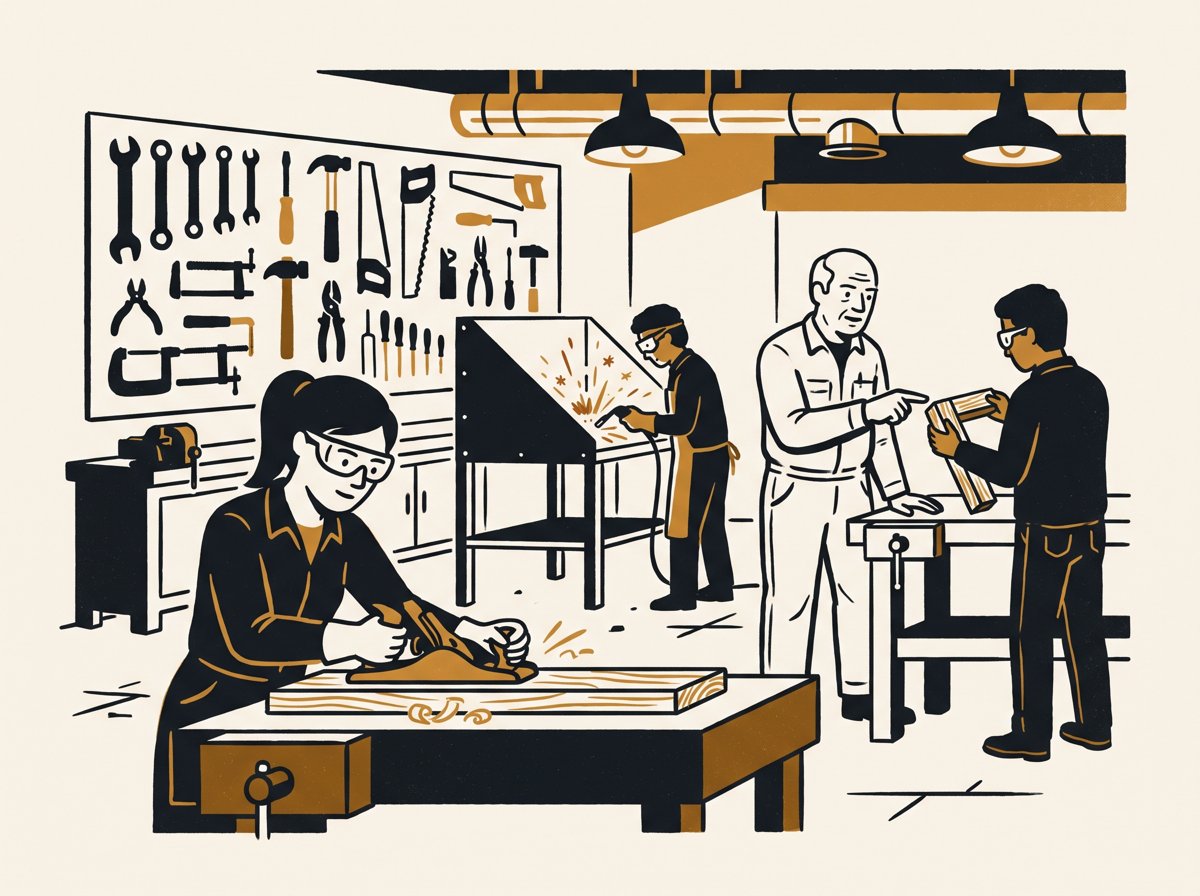
Here is how I picture it, and I will keep it to the kinds of things, because the people who run schools decide the rest. Two halves and a front door. One half trains the trades this town cannot hire: plumbers, carpenters, electricians, welders, machinists, industrial mechanics, the people who fix heating and cooling. The French college already teaches every one of those trades, in Ottawa and in Orléans. None of them here. It ran welding and machining in this town for years, in the high school's shops, starting in 2010, and the first level of a trade is something a grade eleven student can finish before graduating. That is a schedule with the wrong town on it.
The other half trains the people who care for us: practical nurses, the way the college already does here with the hospital; personal support workers, the ones our older residents and their families lean on, at the hospital, in the long-term care homes and at home, including at the end of life; and, later, the paramedics whose advanced students already do their placements here. The province already pays the tuition of nursing students who train here and then stay to work in the region. The county is building a bigger home for older residents in this town, and it had to train its own personal support workers to staff it. The need is here, on the record, in the county's own plans.
And the front door. A trade or a diploma is a way to make a living. A business is a way to make a life here. So the third thing is a place to start one. The county already runs a program that hands a young person start-up money and a coach. The local development corporation already lends to young owners. Neither of them has a room where a welder who just finished her ticket can sit down with a retiring welder who wants to sell his shop. Try to find a shared workspace or a small business incubator anywhere in Prescott-Russell. I know of none. A campus gives those people a table and a door, and it costs almost nothing, because the programs already exist. Learn a trade, then open the shop. Train as a nurse, then run the clinic's books. That is the loop, with the last piece on it.
None of this is a promise of a program, because the college decides what it teaches and where. It is the list I would try for, carried into that meeting in the order I would ask: what already runs here and can grow, what ran here and can come back, and what has never been tried here and should be.
The meeting only a mayor can call
No private citizen can call this meeting. A mayor can, and it costs the town almost nothing. Here is who would sit at that table: the college, the hospital, the school boards, the region's workforce board, the employers who cannot hire, and the Counties, the bigger local government Hawkesbury sits inside. One table, one question: what would it take, and what do you need from the Town? If the answers point somewhere, the Town can put its name behind them. That happens in public, by a vote of council. I cannot force anyone to come to that table, and I will not pretend I can. What I can do is make Hawkesbury the easiest yes in eastern Ontario.
The honest ledger: what a mayor can and cannot deliver here
My whole platform runs on the real powers of the office.
- Call that meeting, and keep calling it
- Put the Town's name on applications for money, by a vote of council
- Keep pushing for it with ministers, the people who hand out the money, and the Counties
- Set up a way of choosing a site that Town staff run in the open, and that anyone can take part in
- Put the incentives council approves into the budget he brings forward
- Fund or run a college. Colleges answer to the province and to their own boards
- Spend a dollar without a council vote
- Approve another government's grant. The Town applies, others decide
- Pick the site. The open process picks it
- Force the hospital, a school board or any employer to sign
Every promise on this page comes from the left column. If you ever catch me promising from the right column, hold it against me.
The money, and the building
With what money? Mostly not yours, and never behind your back. The province has set aside serious money to train people for jobs that are sitting empty. The federal government helps pay for community projects like this every year. Those are the kinds of places an idea like this would have to go looking. If this town ever put anything in, council would set the amount in public before a dollar moved. And I would not want the town owning a campus or paying to run one. Whoever owns the building carries the building. That is the normal way these things get built. I have spent my working life on the building side of them.
Which building? I am not going to name one. Not today, not later, not if I win. The moment a candidate or a mayor names a building, he has put his thumb on the scale. He may also have put money in somebody's pocket. If this ever becomes real, the rules for choosing go public, Town staff run it, and any owner can put a building forward. And I will put my own rules for staying out of it in writing. Before it starts, not after.
And both languages, or it does not deserve the name. The French college is where the conversation starts, because it is the one already training people here. The table grows from there. The English-language side of this region's training belongs at that table too, and every board's kids belong in those shops. A border town that trains in both languages is the whole advantage.
What I cannot promise, and what I will try
I cannot promise you a building before the partners have signed. That is how towns end up stuck with a building nobody uses. I cannot promise a ribbon cutting on a date, and I cannot promise you a campus, because the partners hold the pens that sign one. What I can promise is to try for it, in public. The meeting called, the asking done, and a straight answer either way. If a partner says no, or the numbers say no, I will tell you plainly, within days, and what remains is still worth having: the problem named, the table standing, and a town that asked out loud. Everything the law lets me tell you, I will tell you. When the law makes a meeting private, I will tell you that too, and why.
I build for a living. You do not pour concrete before the ground is ready, and you do not promise the ribbon before the partners sign. The ground here is ready. The college already trains people here. The hospital already hires them. The kids are still leaving. What this needs is somebody willing to call the meeting. That is a job. I am applying for it.
Train here. Work here. Live here.
The receipts
- This page makes no claim about money, no claim about a site, and no claim about a partner. The facts it leans on are public and you can check them today. La Cité collégiale has trained practical nurses at the Hawkesbury hospital since September 2022, and the college's own page tells its students they must be willing to travel to the Ottawa region to finish some of their work placements. The hospital's own website says it is an official teaching site with academic affiliations to the University of Ottawa and La Cité, and its placements page lists medical residents and students, personal support workers, practical nurses and advanced care paramedics. The college's campus page, as saved by the Internet Archive on 14 January 2026, lists a Campus de Hawkesbury at the catholic regional high school on Kitchener Street; the copy saved on 21 June 2026 does not, and neither does the live page. The college's apprenticeship calendar for 2026, read on 3 September 2026, shows no Hawkesbury dates. Radio-Canada reported the end of the automotive technician programme on 22 May 2025. Everything else here is an idea, and it is labelled as one.