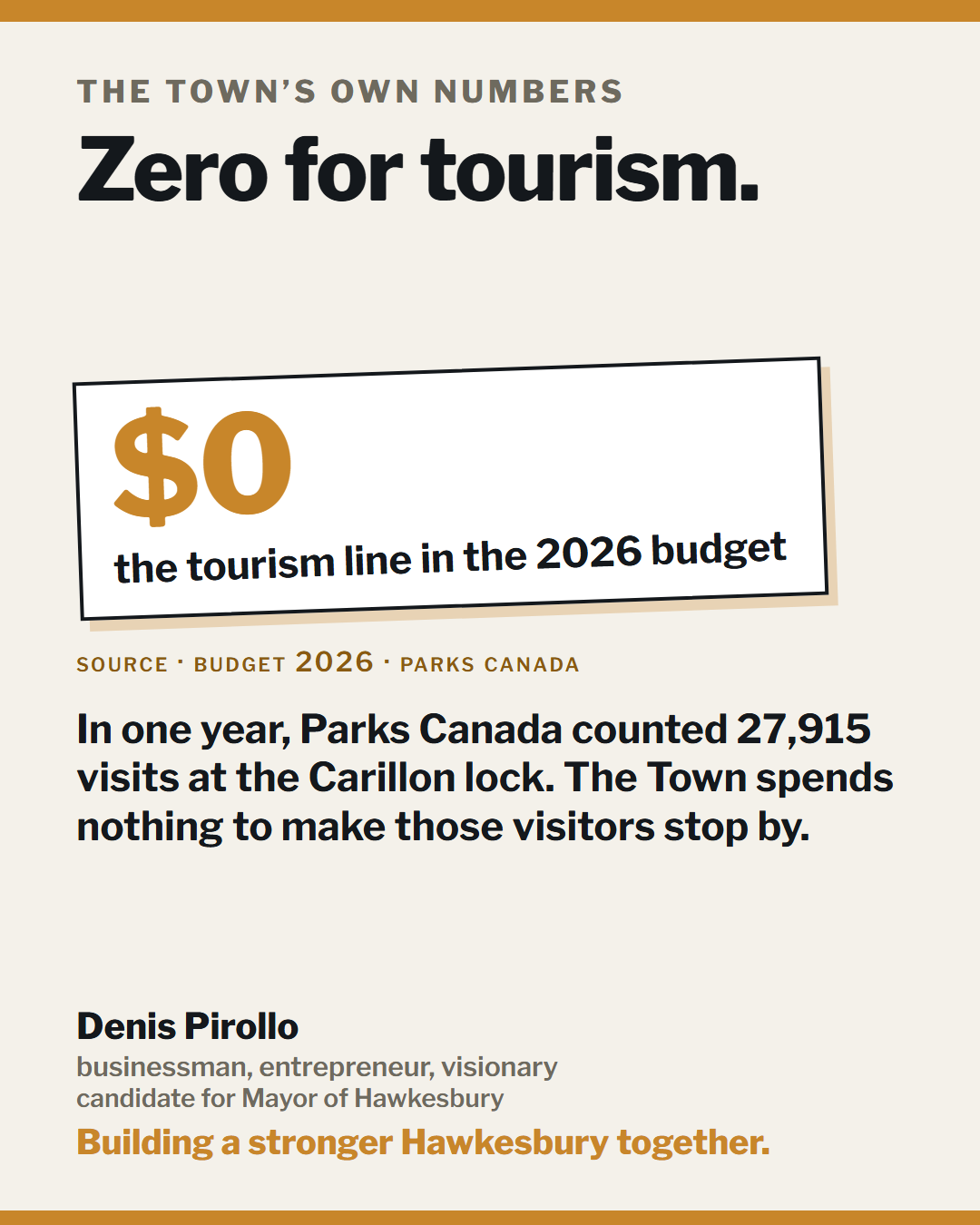
The tourism line in the budget reads $0. Here is who fixes that.
The Town's budget has a line for tourism, and it reads zero. The street, the river and the festivals that fill them are one economy. Here is the plan to run them as one. It also names who has to vote on each piece.
Stand on our waterfront for an hour and count the boats. The Carillon lock sits just downstream of us. In one year, Parks Canada counted 27,915 visits there. Boaters and visitors already travel this river. The Town spends nothing to make them stop by.
The Town's own budget book has a tourism line printed in it. Line 950, tourism: $0. It is just left empty, year after year. The job of bringing people here has no budget of its own.
First, what I will not do
You will not hear me attack a dollar this Town spends on an event. Every event we still have is held up by volunteers: clubs, service groups, somebody's kitchen table. Those people are carrying this town on their backs. The businesses that write sponsorship cheques are carrying it with them. Sometimes an organizer steps back. Sometimes the paperwork and the insurance get too heavy. Either way, the event just dies. That is how the system is built today, and it is nobody's fault.
So my plan starts with partnership. Keep the volunteers, keep the sponsors, and add the one thing the system is missing. An owner. Somebody whose job is to make the street, the river and the calendar earn money.
Why the street, the water and the festivals are one job
A festival fills Main Street. The crowd walks the street and spends in the shops. The shops earn enough to sponsor the next event. The river is the reason half those visitors came at all. That is one loop, one economy. Break that loop anywhere and all three pieces weaken together. That is why my platform treats them as one point. It is why this plan treats them as one job.
The street itself is point 1 of my platform. Main West gets rebuilt in 2027. The roads plan says exactly how I will work that rebuild. This plan is about what the street is for once it is fixed. Ontario's own population forecasters expect this county to grow by half again between 2025 and 2051. The visitors and the new residents are coming to the region either way. The question is whether they stop in Hawkesbury. People stay where there is work. They invest where the street is alive. That is how points 3 and 4 of my platform lean on this one.
The downtown improvement budget has not gone up in six years. That is the money the downtown businesses pay in for their own street.
- Point 2 of 5 Take a walk with me. This is our Main Street. Keep swiping and you come out at the water.
- Main Street Lights back on. Shops open, awnings out, somewhere worth parking for. A downtown earns its keep or it empties out.
- Our festivals Somewhere to gather. Festivals are the days people come downtown, stay a few hours and spend it here. That is the whole point of them.
- The waterfront The river we own. We live on a river most of us only drive past. A waterfront we actually use is the cheapest attraction we have.
- One job Three at once. Those three are one job. A downtown worth walking, a river we actually use, and reasons to gather again.
How we got here
Who holds each piece of this job
Like the roads, this job runs through every level of government.
Council is the one that can actually move the biggest pieces: a policy for events, a written job for tourism, the master plan waiting for its vote, and the budget that pays for all three. Every one of those needs four votes of seven at the council table. The downtown businesses have their own association, funded by the money they pay in, to improve the street. They are the Town's natural partner on the street.
The United Counties of Prescott and Russell walked away from tourism in 2021. In September 2025 they came back through a new agency, on an eighteen-month trial. The mayor of Hawkesbury holds one seat of eight at their table. This year's Main Street deal proves that county money moves when Hawkesbury shows up with a plan and asks. The county quit tourism for four years. Its towns did not have to wait. Any of the eight can step up with its own plan and take it to that new agency. Hawkesbury can be the one that does.
The region's tourism organization has already offered to write the plan. Ontario hands out money for festivals and events every year. It runs separate grants for francophone communities, and that is exactly what we are. A grant is money the Town has to apply for. Those programs run on clocks. The applications have deadlines every year, whether or not anyone in Hawkesbury is watching.
Parks Canada already runs the lock that puts 27,915 visits a year on our doorstep. The federal government funds local festivals through a program that runs every year. That program has a deadline. For next summer's events, it lands this fall. Ottawa also runs a summer jobs program that pays student wages. That is a direct answer to the volunteer shortage every organizer here knows.
None of that money asks for a tax increase. It asks for somebody whose job is to send in the applications. And it asks for a council that votes to let them.
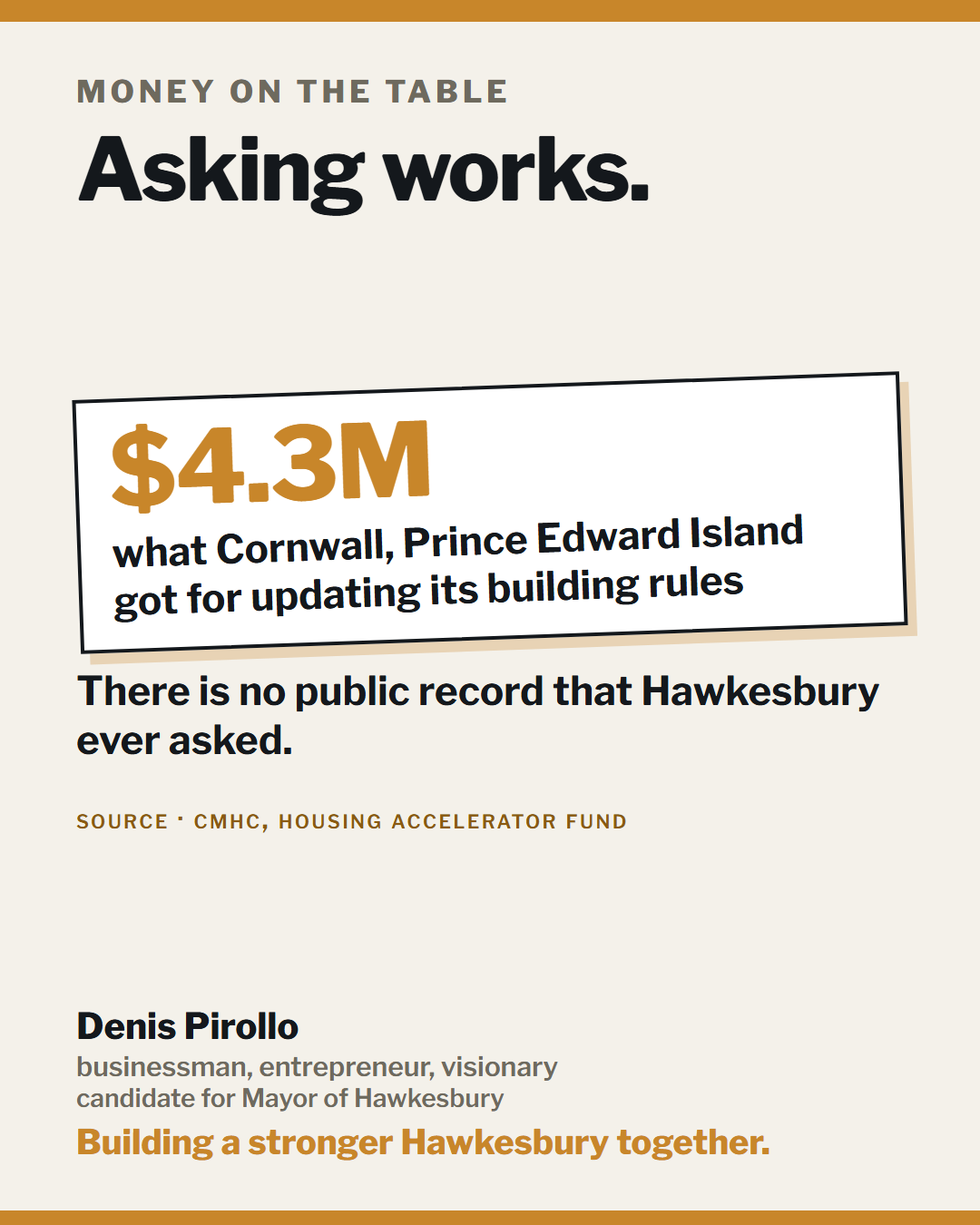
And asking works. Cornwall, a town in Prince Edward Island smaller than ours, got about $4.3 million from the federal government for updating its building rules. There is no public record that Hawkesbury ever asked. It was a different program, but the lesson is the same. The towns that show up with applications get the cheques.
The six moves, and who votes on each
A mayor of Hawkesbury has one vote of seven.
- My pen Give the zero an owner. The mayor personally writes the 2027 budget. I will write a tourism and events job into it. That means one person who answers for visitors, grants and the calendar. That owner gets a target and files a public report. Council can change it, and the debate happens in the open.
- My pen An events policy that carries the paperwork. Today the Town's own events guide puts the insurance, the certificates, the electricity and the toilets on the volunteers. Champlain Township next door publishes an events policy. It has a pot of money organizers can apply for. It also has a rule that lets the township's own insurance cover an event the township runs together with the organizers. I will put a Hawkesbury policy built on that model in front of council for a vote. Four votes of seven.
- My pen One sponsorship menu for every event. One festival here already publishes its sponsorship levels, with local business names on every one. That way of doing it belongs to the whole calendar. The Town's events owner offers one menu to the downtown businesses, the Chamber of Commerce and the sponsors already writing cheques. Then volunteer organizers stop chasing sponsors one door at a time. Local businesses buy a season instead, because a full street is worth money to them.
- Application A grant calendar with an owner. Federal money for festivals. Provincial money for events. Grants for francophone communities. Student summer wages. Each one has a deadline every year. The events owner keeps the calendar and gets the applications in on time. Every fall, that owner reports which applications went in and what came back.
- My pen Life at the waterfront before concrete at the waterfront. The Town's own plan went to council for a vote in June. Residents told its authors what they want down there: concession stands, vendors, patios with live music. None of that needs a construction season. It needs permits, a rental on the water, and a calendar that puts events beside the river on purpose. Towns up this same river already run that playbook.
- My pen Report what the calendar earns, every year. The goal gets written down: events that pay their own way through sponsorship, vendors and grants. Then a public report every year. It shows what each Town-supported event cost, what it brought in, and what changed.
What I cannot promise, and what I will try
I cannot promise you a headline act, and I will not invent a festival from a podium. Good events come from organizers, and what I will try for is a Town that makes their job lighter. I cannot hand you a number for what tourism will bring in either. Anyone who puts a number on that for a town with a zero line is guessing, and I do not campaign on guesses. The events this town already loves belong to the volunteers who run them. The credit stays theirs. The Town's part is the paperwork, the insurance and the grant applications. The Town carries that, and the next event dies of old age instead of exhaustion.
I have spent my working life making things earn their keep. This town owns a main street that is being rebuilt. It owns a riverfront most towns would kill for. It owns a calendar of events held up by people who love this place. Three things this town owns, and a tourism line that reads $0. Give them one owner, one policy and one sponsorship menu, and they start paying this town back.
One street. One waterfront. One calendar. One job.
The receipts
- Schedule A to By-Law 4-2026, Town of Hawkesbury · the tourism line at $0 and the downtown improvement levy, which is the money raised for the downtown, 2021 to 2026.
- Parks Canada attendance open data · Carillon Canal National Historic Site, 27,915 visits, 2023-24.
- The Review, February 9, 2024, "Prescott-Russell switches tourism regions" · the county tourism cuts and the quoted answer to the regional plan offer.
- Town of Hawkesbury Parks and Recreation Master Plan, presented May 2026, before council for a vote June 22, 2026 · the waterfront chapter and what residents asked for.
- Town of Hawkesbury Special Events Guide, January 2024 update · what organizers must carry today.
- Champlain Township special events policy · the money organizers can apply for and the insurance rule for events the township runs together with the organizers.
- Canada Mortgage and Housing Corporation news release, 2024 · Cornwall, Prince Edward Island's Housing Accelerator Fund agreement, about $4.3 million.
- Ontario Ministry of Finance population projections, 2025 to 2051 · the county growth outlook.
- The Review, September 28, 2025, "Destination Prescott and Russell is the new local tourism agency" · the launch at the Counties' council on September 24, 2025, the $200,000 from FedDev Ontario and the 2025 to 2030 strategy; the Counties' own tourism page · the eighteen-month pilot partnership with the development corporation.