Worst streets first, every outside dollar chased: the roads plan
The Town's own plan already says what the roads need. Here is what it says. Here is who controls each part of the fix. And here is exactly how I will use the mayor's job to get it done.
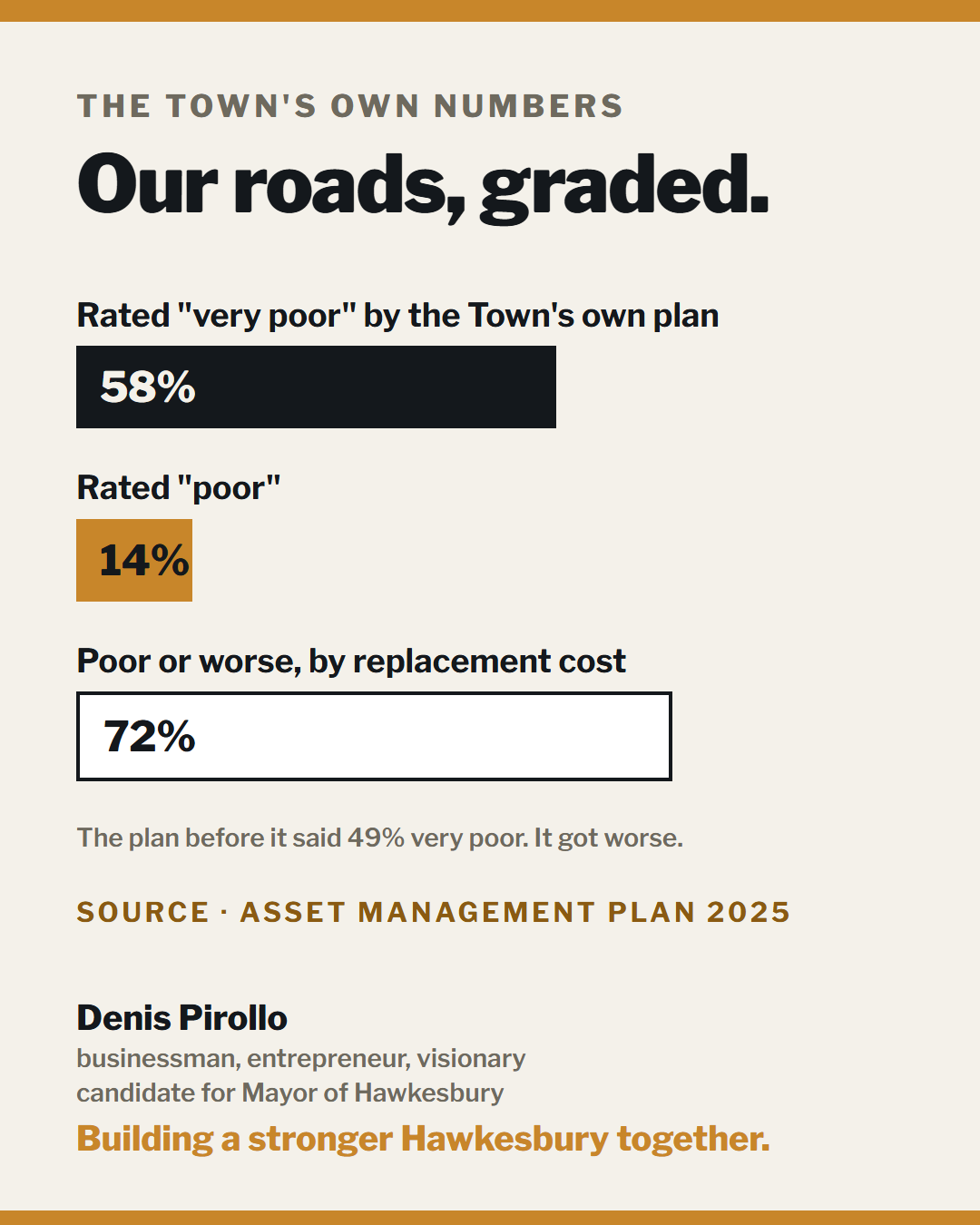
In 2025 the Town published its Asset Management Plan. That is the Town's own written list of what it owns and what condition the Town says it is in. That plan grades 58% of our road network "very poor." Another 14% is "poor." Together that is 72% of the network, measured by what those roads would cost to replace. The plan before it said 49% very poor. It got worse.
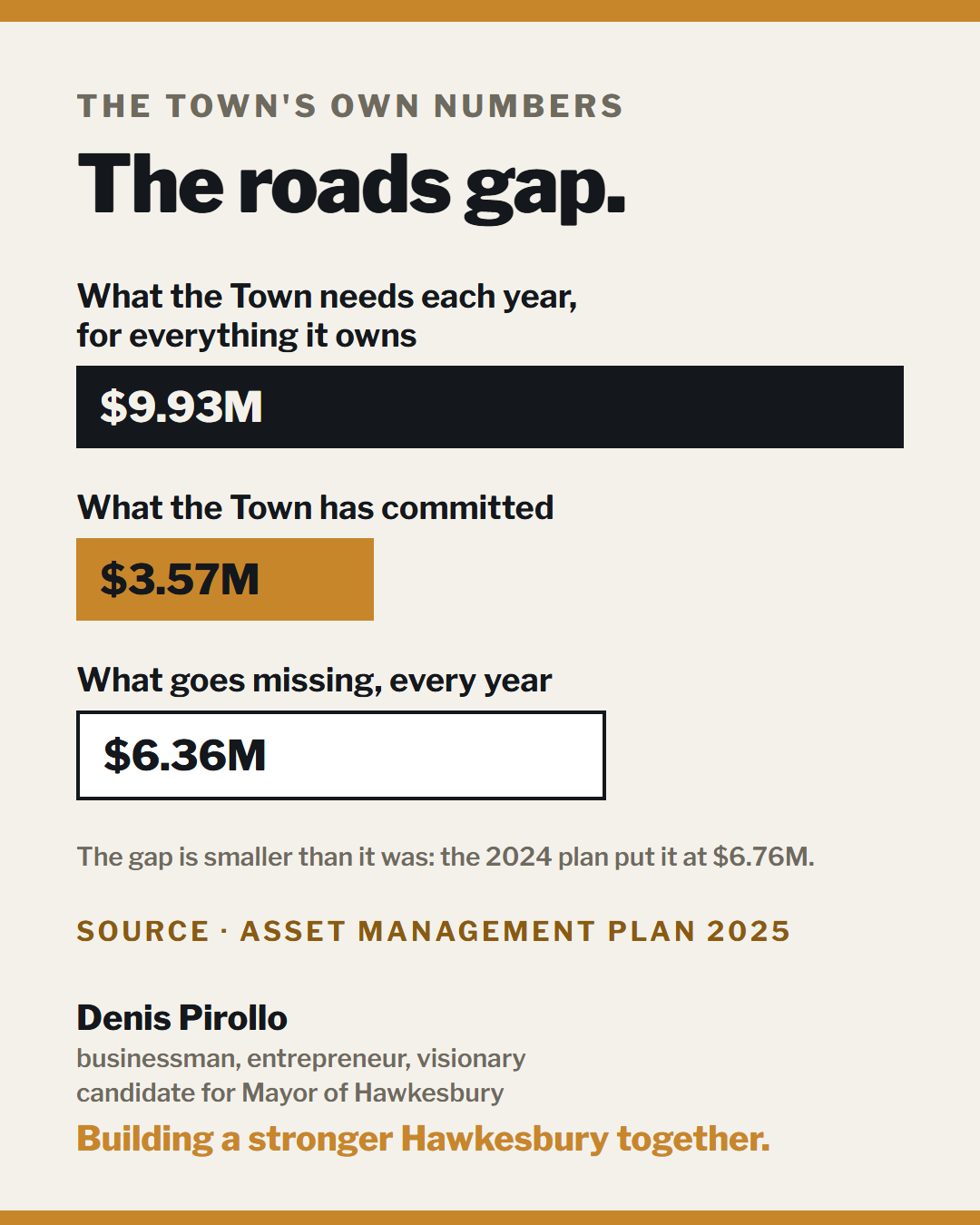
The same plan puts a price on the fix.
Between the 2024 plan and the 2025 plan, the gap got smaller. The roads themselves still got worse.
Why roads come first
In my trade, nobody builds on a bad foundation. Roads and the pipes under them are the town's foundation. Every new business, every new building, every new home has to sit on them.
Points 2, 3 and 4 of my platform ask people to invest here. Revitalize Main Street. Keep our young people. Bring in investment for development. None of that happens on streets that crack, flood and close. An investor reads a town the way I read a job site. They look at the ground first.
And growth pays back. New buildings and new businesses start paying town taxes too. Right now the same bill is spread over the property we already have, and that is not much property to spread it over. More buildings, and more valuable ones, spread it wider.
How we got here
Who owns the road under your tires
Fixing roads in Hawkesbury means working with three levels of government at once.
Main Street runs about 3.3 kilometres through town, and it is a municipal road. That means it belongs to the Town, not to the Counties or the province. In April 2025 the Counties were asked to take it over. They said no. So the Town keeps the maintenance bill. Out of every municipal tax dollar, 67 cents stays with the Town. The rest goes to the Counties and the schools.
The United Counties of Prescott and Russell (UCPR) run the county roads. They also collect about a quarter of your tax bill. The mayor of Hawkesbury holds one seat of eight at their table, where the votes are weighted by the number of voters. The July deal on Main Street is what that seat is for. And the traffic numbers make our case: 81,930 vehicles in 12 days at the west end of Main Street. That traffic is regional. Regional traffic should bring regional money. Going to get it is the mayor's job.
Ontario runs a program called Connecting Links. It pays for stretches of road the province has put on its own list. It pays up to 90% of costs, with a cap now set at $5 million per road project. The latest round put $46 million into 21 projects. The 2027-28 window is open now. Ontario also sends money every year on a set formula, which just means the amount is worked out by a fixed rule rather than decided each year. That is $1.2 million from the Ontario Community Infrastructure Fund, for roads and sewers. That grant is not guaranteed to grow. It dropped $133,000 from 2025 to 2026.
The old federal gas tax is now called the Canada Community-Building Fund. It sends us $334,000 a year by formula, and that money is already coming in. The job is spending it in the right place.
None of that money needs a tax increase. It needs applications filed on time, and a council that votes to file them.
The part nobody campaigns on: the votes
A mayor of Hawkesbury has one vote of seven. If the vote ties, the motion fails. A mayor does not run the road crews. Work moves when four of seven vote yes. Then staff carry it out through the Chief Administrative Officer, the Town's top employee.
Since May 1, 2025, Hawkesbury is a strong-mayor municipality under a provincial rule. That means the mayor writes the yearly budget himself and brings it to council. A new mayor's first budget is the 2027 budget.
- My pen The 2027 budget gets written to the plan. Writing the budget is the mayor's own duty, and it is due by February 1. I will write the roads pages straight from the Asset Management Plan. Worst streets first, each one with a price and a date. Council can change it, and every change gets debated in public.
- ApplicationCouncil vote The Connecting Links money gets chased at every window, starting with the one already open. The 2027-28 application, McGill Street and Chenail Boulevard, went to council on 14 September 2026. The filing deadline is 12 November. If the province says yes, the first roads vote I ask council for funds the Town's share and puts shovels in the ground. If it says no, the first roads vote I ask council for files again at the next window, in public, four votes of seven, every hand on the record.
- Streets get done once. The Town's own plan already says the surface work should line up with the pipes underneath. That policy becomes the rule for every project on the list.
- Council vote Every big job gets a second opinion on price. Pricing jobs is what I did for a living. Four trade licences. My own licensed construction company. My own payroll to meet. Before the Town commits to a big project, I will push council to require an independent second opinion on the costs. And I will read the quotes myself.
- Council vote The worst-first list gets published. The road crews answer to the Chief Administrative Officer. The strong-mayor law lets a mayor direct staff in writing, but only for the budget and the other strong-mayor powers. A priority list that outlives any one mayor should belong to council, which directs the work through that officer. So I will bring the motion. It asks for a public priority list, street by street, that residents can check for themselves.
- County motion The county seat gets worked. I will use it loudly. The July deal proves Counties money is gettable. It should not take a crisis to get it.
- My pen Every year, a public report card. Which streets got done. What each one cost. What moved on the list.
What I cannot promise, and what I will try
In its own budget, the Town expects its reserves, the money it has set aside, to be $6.2 million by the end of this year. Fixing and replacing everything the Town owns, roads, pipes, buildings and equipment, is supposed to cost about $9.9 million a year in the Town's own plan. So the money set aside is worth about seven months of that yearly bill. The Town is not broke. But nobody can promise you the hole gets filled in one budget. What I can promise is to try to close it faster every year, in this order: worst streets first, every outside dollar chased, every project done once, every year reported.
And asking works. In 2024 council wrote to the province about policing costs. The next year the provincial cheque went up $143,000. In 2026 it stands at $2,329,400.
Main West, said straight
The 2026 budget put about $6 million into rebuilding Main West. In June, council postponed it to 2027. The province is trucking contaminated fill straight through the work zone, about 2,500 truckloads. I do not fault that call. The job is not happening this year. Delivering it falls to the next council, and I will read the quotes before the work starts.
I have spent my working life pricing jobs, meeting payroll, standing behind the work. Roads are a job. A job needs a proposal, a price, a clear order of work, and somebody who checks it. That is what I am offering.
The worst ones first. Done properly. Done once.
The receipts
- Asset Management Plan 2025, Town of Hawkesbury · road condition grades and the yearly cost of fixing and replacing what the Town owns.
- By-Law 4-2026, Schedules A and B · the Town's adopted 2026 budget, including the Main West line and what the Town expects to have in reserves.
- Administrative report AG-02-2026, regular meeting of council, June 22, 2026 · the Main West postponement and the provincial trucking.
- Connecting Link Agreement coverage, Le Carillon, July 2026 · the Counties' $468,000 share.
- Provincial Connecting Links announcement, February 6, 2026 · the $46-million round and the $5-million cap.
- The 2027-28 application, McGill Street and Chenail Boulevard · Town of Hawkesbury council, 14 September 2026, recommendation 2026_REC_52; filing deadline 12 November 2026
- Ontario open data · Ontario Community Infrastructure Fund (OCIF) formula allocations; Ontario Municipal Partnership Fund (OMPF) municipal allocations, 2024 to 2026.
- Infrastructure Canada open data · Canada Community-Building Fund, 2025-26.
- Traffic counts as reported by The Review, April 21, 2025.
- Town of Hawkesbury, "Understanding your municipal taxes" · the 67-cent split.